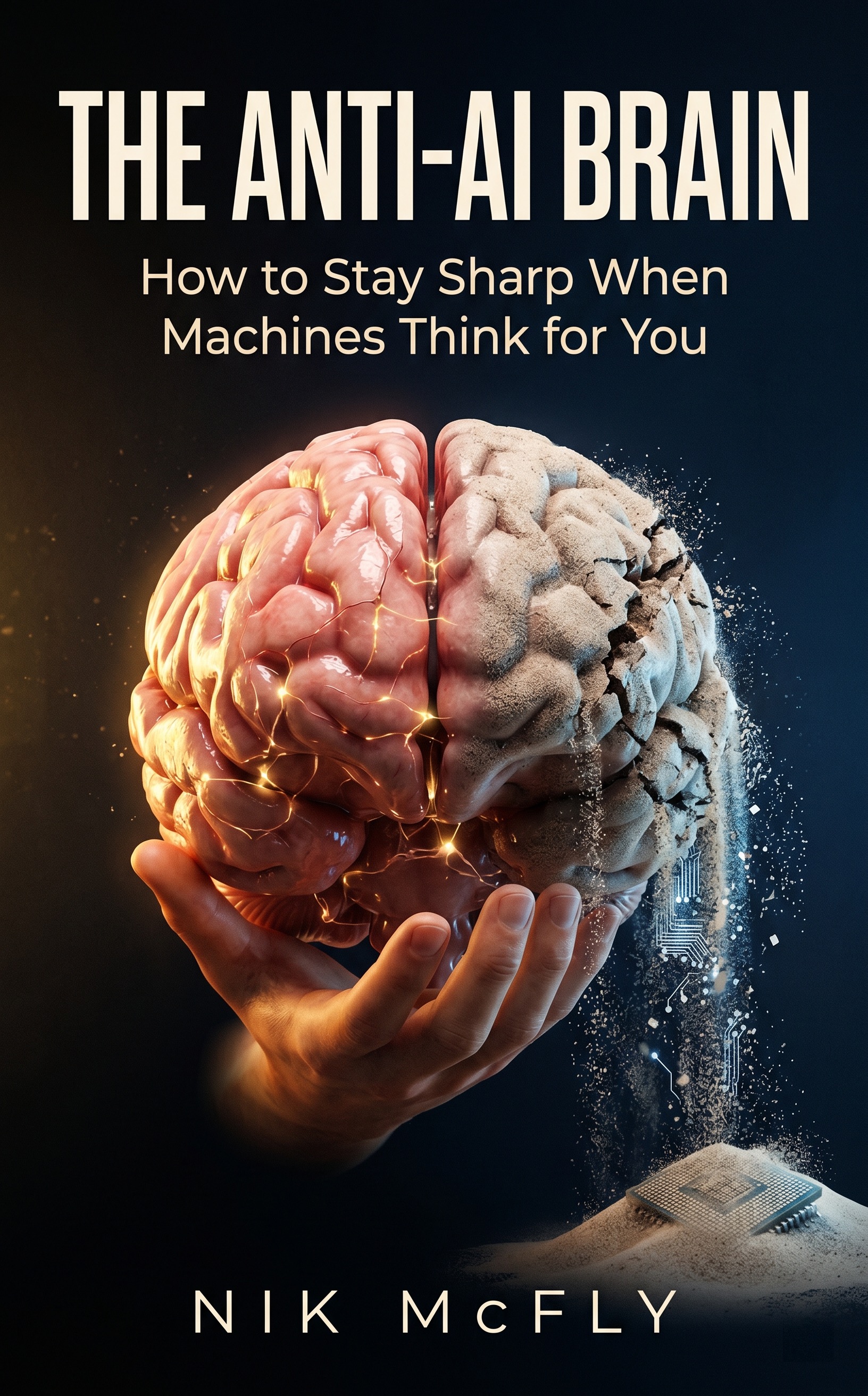
New book · Launches in 6 days

Your intelligence isn't fading.
It's migrating.

Bring it back in 30 days. Without quitting AI.

MIT measured a 55% drop in deep-thinking brain activity after one ChatGPT session.

Pre-order locked at $0.99 · $9.99 at launch

−55%*1

Deep-thinking activation after a single ChatGPT session

83%*1

Couldn't recall a sentence of what AI just wrote for them

−17%*3

Exam performance when students had unsupervised AI access

30days

The exact window the protocol rebuilds the circuits in

From Day 0 to Day 30.
Here is what changes.

Three moments. One protocol. Same person.

You open Claude before you think. You reach for your phone between sentences. You finish the day tired, with nothing you made. Your recall is thinner than it was three years ago. You notice. You keep working.

The first week feels wrong. Reading a chapter without a screen takes real effort. Writing by hand is slow. Sitting with a hard decision instead of prompting it feels like wasting time. The discomfort is the repair.

You still use AI. You use it harder than most people. You also think before you prompt, write before you paste, and decide before you ask. The circuit is back. The fog is gone. You use the tool. It does not use you.

Can you still
prove you think?

In 1950, Alan Turing asked whether a machine could fool a human into thinking it was human. That was the test for machines.

In 2026, the question has reversed. The test is for you.

Not type. Not prompt. Not approve a draft you did not write.

Think. From a blank page. Under pressure. With no machine in the loop.

If the answer is no, or if you are not sure, your brain has started the transfer. The circuit that composes an argument, weighs evidence, chooses a word under pressure, is quieter this year than last. The MIT data says it, Microsoft Research says it, the University of Pennsylvania says it. Your mirror says it too, on the mornings you pay attention.

This is the reversed Turing test. The book in front of you is the 30-day answer.

Four circuits. Four recoveries.
Thirty days.

The protocol targets the four cognitive functions AI degrades fastest. Each one has a recovery path. Each path is backed by research you can verify.

Recover a 90-minute focus block without a phone in the room.

The MIT Media Lab fitted EEG sensors onto 54 people writing essays. The ChatGPT group showed roughly 55% lower alpha-theta coupling in the prefrontal regions that run deep attention. Over 83% could not recall a sentence from the essay the machine wrote for them. The protocol rebuilds the attention substrate those sensors measured. By Day 14, most readers report reading for an hour without touching a device.

Kosmyna et al., MIT Media Lab, 2025

Encode what you read. Recall it without a search bar.

Sparrow's 2011 study at Columbia found that people who expect to look something up later fail to encode it in the first place. Your working memory is not broken. It is not being loaded. The protocol reinstalls deliberate recall through handwriting, teaching, and spaced retrieval. You stop storing pointers and start storing the thing.

Sparrow, Liu, Wegner, Science, 2011

Hold a hard problem for an hour without prompting it.

Microsoft Research surveyed 319 knowledge workers in 2025. Higher trust in AI correlated with less critical thinking. Their word was "atrophied." A 2026 RCT — Carnegie Mellon, Oxford, MIT, UCLA — caught the same effect causally. Ten minutes with GPT-5 in a sidebar. Sixteen-point drop on independent test problems once the AI was removed. All of the decline in users who prompted for direct answers. The protocol reintroduces structured cognitive friction: Socratic prompting, steel-manning, deliberate disagreement. You come out of the month able to sit with a question instead of offloading it.

Lee et al., Microsoft Research, CHI 2025 · Liu et al., 2026

Make a call on your own data without a machine in the loop.

Kool and colleagues at Princeton measured the cost humans pay to avoid cognitive effort. The anterior cingulate cortex posts the bill. When AI lowers the effort price of a decision, your brain signs off on the outsourcing in milliseconds. The protocol raises the price back up until you stop automating the choices that belong to you.

Kool et al., Journal of Experimental Psychology, 2010

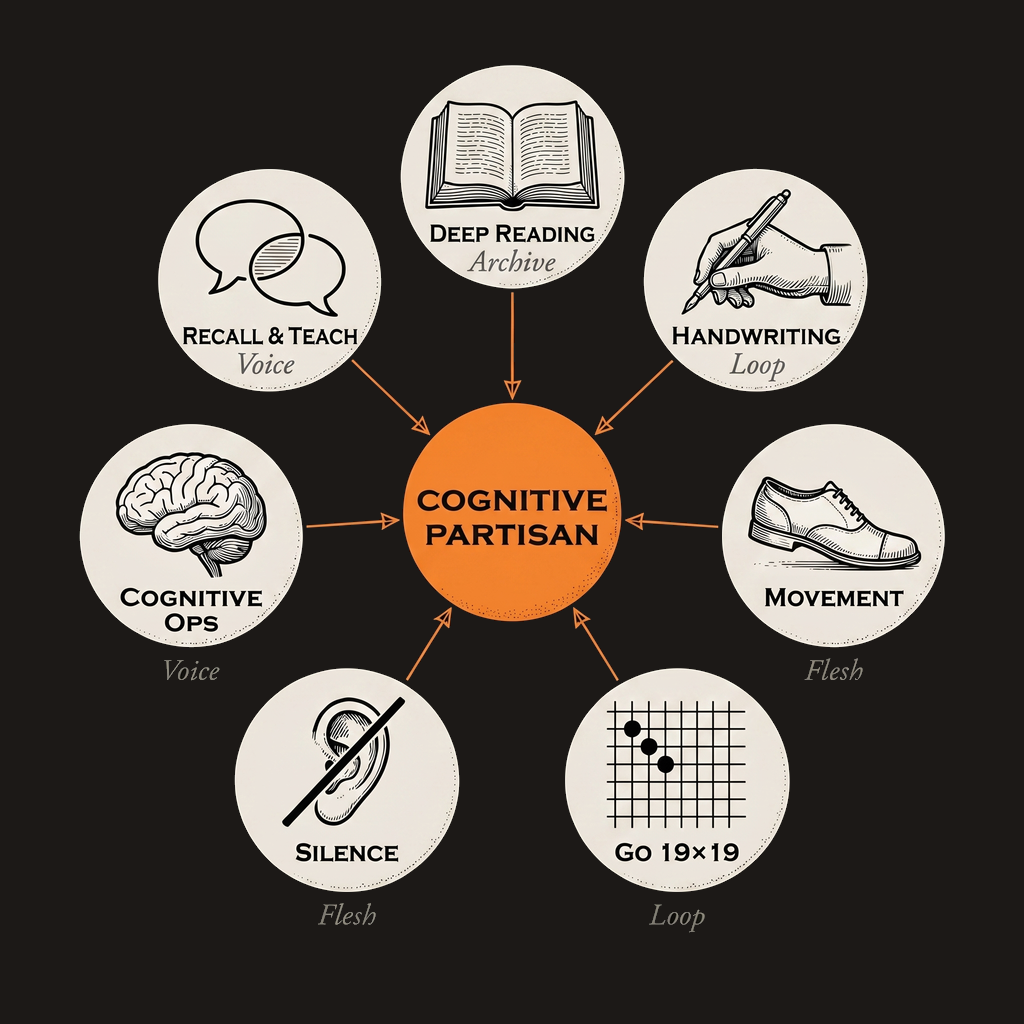
Seven practices.
Four weeks. Zero fluff.

Each practice targets a layer of the cognitive stack. You do not need to understand the neuroscience to follow the protocol. It is there if you want it.

Practice schematic: a central Cognitive Partisan node connected by seven arrows to the seven practices — Deep Reading, Handwriting, Movement, Go 19×19, Silence, Cognitive Ops, Recall and Teach — each labelled with its cognitive layer
Seven practices · One center · Four layers
01

Deep Reading.

One paper book. Sixty minutes. No notification device within reach.

02

Handwriting.

Twenty minutes a day, longhand. Van der Meer's EEG work shows why typing does not substitute.

03

Movement.

Forty-five minutes of physical load. The brain that grows is the brain with oxygen pressure.

04

Strategic Play.

Go, chess, or equivalent. Four-thousand-year-old games that no AI coach can shortcut for you.

05

Silence.

Thirty minutes a day with no phone, no input, no task. The default mode network does the work you cannot schedule.

06

Cognitive Ops.

Claude as sparring partner, not ghostwriter. Socratic mode, steelman mode, falsification mode.

07

Recall and Teach.

Explain a concept without looking it up. The circuit that stores is the circuit that retrieves.

08

See the full 30-day schedule.

Inside the book →

The Anti-AI Brain on a walnut desk beside an open handwritten journal showing a Day 4 entry — 45-minute walk, morning pages by hand, phone in the kitchen — a fountain pen, and a dark ceramic coffee cup
The book is built for the desk, the journal, and the pen. Not the feed.

Most readers take the quiz first.

Ten questions. Two minutes. You get a score from 0 to 30 and a tier: Ghost, Partisan, Operator, or Sovereign. The email report shows you which of the four circuits is thinnest and where the protocol starts for you.

Take the Anti-AI Brain Score quiz →

MIT Media Lab

2025

54 participants. 55% reduction in deep-thinking brain activity after a single ChatGPT writing session. Recovery did not occur when the AI was removed.

Microsoft Research

2025

319 knowledge workers. Higher AI trust correlated with atrophied critical thinking. Published at CHI 2025.

University of Pennsylvania

2025

Turkish high school students given unsupervised ChatGPT access scored 17% worse than peers who never touched it. Same tool, different dose, different outcome.

See the full evidence ledger — 35 anchor claims, every source linked →

The book. Plus a bonus stack for pre-order buyers.

Interior spread of The Anti-AI Brain open at Chapter 6, Week 1 — Flesh
Inside · Chapter 6 · Week 1 — Flesh
Launches in 6 days $0.99 locked until launch

Price lock

Pay $0.99 now. Price flips to $9.99 at launch. You pay the pre-order rate even though you read the launch edition.

Bonus stack

Pharmakon system prompt, Anti-AI Seven cheatsheet, Cognitive Audit Claude skill, and the 30-day score report. Pre-order only.

First to read

Pre-order buyers get the book pushed to their Kindle the moment it clears Amazon review. Ahead of the public launch.

  • 10 chapters · 200 pages
  • Kindle edition · $0.99 pre-order, $9.99 after launch Save $9
  • Paperback · $16.99, available day one
  • Free on Kindle Unlimited
  • Part I. The damage. What AI takes and how it takes it.
  • Part II. The neuroscience of recovery. Why two weeks in feels terrible and four feels like waking up.
  • Part III. The 30-day protocol. Day-by-day schedule.
  • Part IV. The philosophy. What cognitive sovereignty means when machines think faster than you.
  • Pharmakon system prompt For Claude and ChatGPT. Injects a "medicine or poison" check before every delegation.
  • Anti-AI Seven cheatsheet · PDF One page. On the fridge by Day 3.
  • Cognitive Audit · Claude skill 90-day early access. Personal diagnostic and protocol, calibrated to your quiz score.
  • Anti-AI Brain Score 30-day report Personalized. Auto-delivered after the quiz.

Bonus value ~$50. Pre-order $0.99. Bonuses auto-deliver after Amazon confirms the pre-order.

Pre-order on Amazon Kindle · $0.99 →

Amazon checkout · Kindle Unlimited day one · Launches in 6 days

Nik McFly, author of The Anti-AI Brain
Builds with AI · Writes AI playbooks

Nik McFly builds with AI every day.

Trained 1,500+ AI operators · Co-founded an AI music company (12M+ streams) · Shipping with machines daily since 2020

Nik's usual books are operator manuals: Vibe Patenting, The Polymarket Files, The Complete AIO Playbook, Digital Dolls, Real Dollars, TikTok Automation Playbook. Technical, operator-grade, written for people who ship.

Anti-AI Brain is the book underneath those playbooks — the cognitive argument for why you should use AI harder than most people without losing the tissue AI consumes in them. He has been watching this migration in himself and in his teams since 2020. Five years later, the research caught up.

The machines he warns about are the machines he keeps shipping with.

Your brain on AI. Your brain on the protocol.

Same person. Different dose.

Circuit Default use of AI Anti-AI Protocol
Attention Fragmented. 90-second average focus before device check. 90-minute deep work blocks by Day 14.
Memory Encodes pointers, not content. Cannot recall last week's emails. Encodes substance. Recalls a chapter a month later without notes.
Reasoning First instinct is to prompt the question. Drafts approved, not written. First instinct is to hold the question. Drafts written, then sharpened with AI.
Decisions Outsourced to the model. ACC fires zero times under pressure. Made by you. AI runs the falsification check after the fact.
Creative synthesis Converges on the model's confident middle. Produces the sharp edge AI cannot generate.
Sleep and mood Three hours of scroll before bed. Flat affect on Monday. Silence before sleep. Clearer Monday. Lower baseline anxiety.
If the AI goes down You stare at the blank page. You keep working.

Questions readers ask before pre-ordering.

01Is this an "anti-AI" book?
No. The foreword opens with the sentence "I wrote parts of this book using the exact machines I am warning you about." The book is a dosage guide. It teaches you to use AI harder than most people do, while keeping the cognitive tissue AI consumes in them. The Greeks called this pharmakon: medicine or poison, depending on the dose. The book is the calibration.
02How much time per day does the protocol require?
About 90 minutes. You already spend that on your phone before noon. The protocol reallocates the time. By Week 2, most readers report a net reduction in total screen time because the work itself gets faster.
03Does it work if I am already deeply dependent on AI?
Yes. Part II covers the neuroscience of why the first two weeks feel terrible and why that is the signal the protocol is working. Over 40,000 studies on neuroplasticity show the adult brain regrows circuits when given the right load. The book uses the research. The protocol applies it.
04Is there an audiobook?
Not at launch. Narration recording is scheduled for Q3 2026. Pre-order buyers get the audiobook at a 50% discount when it releases.
05Why only on Amazon?
Kindle Unlimited reach, print-on-demand paperback without warehouse risk, and the largest English-language book audience on one platform. Direct sales come later with bundles and workbooks.
06When does it launch?
Kindle launches May 2026. Paperback day-one. Pre-order is live now at $0.99. Price flips to $9.99 within 48 hours of launch.
07What is the refund policy?
Amazon refunds Kindle purchases within seven days of purchase, no questions. Paperback refunds follow Amazon's standard 30-day policy. If you read the book and do not want to do the protocol, Amazon will refund you.
08Can I keep using AI during the 30 days?
Yes, with rules. Chapter 7 (Day 9) installs the Socratic Mode Custom Instructions that turn the model into a sparring partner instead of a ghostwriter. By Day 20 you will use AI better than you did before the protocol. You will stop confusing its outputs with your thinking.

All 18 questions on /faq — science, protocol, logistics, refunds →

Read Chapter 1 free first.

The opening chapter lays out the MIT, Microsoft, and Princeton evidence in one arc. If it lands, pre-order is $0.99 until launch.

One welcome email. One message on launch day. No sequences you did not ask for.

Use the machine.
Don't become one.

Thirty days from now, one of two brains will own the body you live in.

The brain that drafted, weighed, struggled, recalled, and chose. Or the brain that approved, tweaked, and sent. You choose which.

Launches in 5d 4h · $9.99 at launch

Amazon KDP verified Kindle Unlimited enrolled 7-day refund window
Research cited
  1. Kosmyna, N., Hauptmann, E., Yuan, Y.T., Situ, J., Liao, X.-H., Beresnitzky, A.V., Braunstein, I., & Maes, P. (MIT Media Lab, 2025). Your Brain on ChatGPT: Accumulation of Cognitive Debt when Using an AI Assistant for Essay Writing Task. arXiv:2506.08872 ↗  ·  MIT Media Lab ↗
  2. Lee, H.-P., Sarkar, A., Tankelevitch, L., Drosos, I., Rintel, S., Banks, R., & Wilson, N. (Microsoft Research, 2025). The Impact of Generative AI on Critical Thinking: Self-Reported Reductions in Cognitive Effort and Confidence Effects From a Survey of Knowledge Workers. Proceedings of the 2025 CHI Conference on Human Factors in Computing Systems. ACM DL ↗
  3. Bastani, H., Bastani, O., Sungu, A., Ge, H., Kabakcı, Ö., & Mariman, R. (Wharton, 2025). Generative AI without guardrails can harm learning: Evidence from high school mathematics. PNAS ↗  ·  Knowledge@Wharton ↗
  4. Kool, W., McGuire, J.T., Rosen, Z.B., & Botvinick, M.M. (Princeton, 2010). Decision making and the avoidance of cognitive demand. Journal of Experimental Psychology: General, 139(4), 665–682. APA PsycNet ↗
  5. Kestin, G., Miller, K., Klales, A., et al. (Harvard, 2025). AI tutoring outperforms in-class active learning: an RCT introducing a novel research-based design in an authentic educational setting. Scientific Reports, 15, 17458. Nature Sci Reports ↗
  6. Liu, G., Christian, B., Dumbalska, T., Bakker, M.A., & Dubey, R. (Carnegie Mellon, Oxford, MIT, UCLA, 2026). AI Assistance Reduces Persistence and Hurts Independent Performance. Three randomized controlled trials (N = 354 + 667 + 201). After ~10 minutes with GPT-5, independent test performance dropped 16 points on fractions and 13 points on SAT-style reading; the decline was concentrated in users who prompted for direct answers, while users who prompted for hints or critique showed no significant decline. Project page ↗